A brief history of Chechnya...

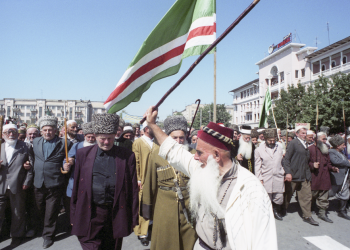
Chechen Republic of Ichkeria (mostly known as Chechnya or Chechen Republic) which is located in the south eastern part of North Caucasus of Eastern Europe, is an independent country since 1991 after the collapse of the USSR (The Union of Soviet Socialist Republics) but under the Russian military occupation since 1999.

1707

The Russian Tsarist troops led by the Astrakhan prince Pyotr Apraxin set off once again for the Caucasus after their unsuccessfull attempts to conquest the region in the 16th century. They suffered a heavy defeat by Chechens.

1785

Russian Empress Catherine II established a Caucasian Gouvernement for the Caucasus and Astrakhan in 1785. The governor was Prince Grigori Potemkin. The Chechens fought bitterly against Tsarist expeditions into their hinterland under Sheikh Mansur Ushurma. The campaigns led by Colonel De Pieri (1785) and Potemkin (1787) ended in Russian defeats.

1801 - 1818

Georgia was incorporated into the Russian Empire in 1801 and became the main base to conquer the North Caucasus. A new wave of misfortune befell the region when infantry general Alexei Petrovich Yermolov was appointed supreme commander in the Caucasus. As new fortresses were built, the Chechens were driven out and the Caucasian Line was shifted from the left bank of the Terek to the River Sunzha. Towns appeared, among them Nazran, Slobniy Okop (Angry Trench), Vnesapnaya (Sudden Attack) and in 1818 Grozny (The Terrible). Eight outlying villages were razed to the ground to make way for Grozny, including Chechana and Sunzha. Local inhabitants were used as forced building labour, a form of collective punishment for resistance.

1819

One of the cruellest expeditions by Tsarist troops took place on 15 September 1819 in Dadi-Yurt. The village, one of the most prosperous in Chechnya, was surrounded and subjected to artillery fire. The inhabitants, many young boys and girls among them, defended their home, flinging themselves onto bayonets. All the men were killed. Of the 140 girls taken prisoner, 46 leaped from a high bridge into the raging Terek below, dragging their guards with them. The massacre of Dadi-Yurt came to symbolise the Yermolov’s merciless rule.

1834 - 1859

The peoples of the North Caucasus were united between 1834 and 1859 under Shamil, elected Imam of Dagestan and Chechnya. The Russian forces were driven from their garrisons in Chechnya and Dagestan. In 1859 Shamil surrendered and was banished to Kaluga in Southern Russia. The fall of Kbaadas, the last bastion of the mountain dwellers, is regarded as the end of the war between Russia and the Caucasus. 750,000 North Caucasians took refuge in the Ottoman Empire, where their descendants still live today as ethnic minorities. Others were settled in their villages, mostly Cossacks and Armenians. Although the uprisings continued, by the end of the 19th century Chechnya was a Russian colony.

1905

The revolutionary mood festering in Russia, and in particular the 1905 Revolution, met with the harsh response of the Tsar’s police, and the effects were also felt in the Caucasus. 17 people were killed during a strike in Grozny when the police fired into the crowd. Hundreds of innocent people were banished. Abrek (lone resistance fighter) Zelimkhan took his revenge on the Russian governors, maintaining his personal campaign until 1913.

1917 - 1924

During the Russian Civil War, the North Caucasians managed to unite once again. A consolidation of various North Caucasian ethnic groups established an union which consisted seven “states” distributed on a national basis and united under a confederative principle within the territories: Dagestan, Ingushetia, Chechnya, North Ossetia–Alania, Circassia, Karachay-Balkaria, the Nogai steppes, and Abkhazia. The independent republic (Mountainous Republic of the Northern Caucasus) was declared on 11 May 1918 at the time of the collapse of the Russian Tsarist empire during the Russian Revolution of 1917 and it was recognized by the Ottoman Empire, Germany, Azerbaijan Democratic Republic, Armenia,  Georgia Democratic Republic, Ukraine, Bulgaria, Belarus, Latvia, Estonia, France, Finland, United Kingdom, USA, Italy, Austria-Hungary, Poland, Don Republic, Japan and Kuban People’s Republic. In 1920 General Denikin chose to attack Chechnya rather than Moscow and Petersburg, destroying countless villages. The Chechens fought him under Umar Khaji and Aslambek Sheripov. The Bolsheviks who appeared to offer assistance ended up occupying the country under Orjonokidze. They killed all the Chechen leaders, including Aslambek Sheripov, and founded the Soviet Mountain Republic. This was dissolved in 1924, and one by one the Soviet Republics of the North Caucasus were established: Karachay-Cherkessia, Kabardino-Balkaria, Ossetia, Chechnya and others. The Chechens continued to rebel, and the Soviet powers reacted with cruel reprisals, especially under Beria.

1930s

The Chechens continued to rebel, and the Soviet powers reacted with cruel reprisals, especially under Beria. Until the late 1930s Stalin raged against the Chechen intelligentsia. Two reforms of the alphabet, with the introduction of Latin script in the twenties and Cyrillic script in the forties, broke the nation’s cultural backbone. The language and religion were massively suppressed.

1944 - 1956

Although many Chechens earned the highest honours in the war against Germany, 550,000 Chechens were deported in Eastern Kazakhstan and Siberia on 23 February 1944, accused of collaborating with Hitler’s Nazis. The official reason given by the Soviet Union for deporting the Chechen-Ingush people was the accusation that they had failed to support the Soviet Union sufficiently against Hitler’s troops and that they had even collaborated. The real reason was the existence of opposition groups consisting largely of deserters and conscientious objectors who destabilised the region by attacking Soviet institutions, military bases and collective farms in the region. 60% of the Chechen population perished during this ordeal. The ancient Chechen chronicles inscribed on parchment scrolls, the tyaptari, and thousands of Chechen books – scientific and literary works alike – went up in smoke on the central square of Grozny. After Khrushchev’s secret speech in 1956, the Chechens gradually returned, although for a long time they were not allowed back to their mountain villages.

23 - 25 Nov. 1990

Under Gorbachev perestroika brought a thaw in the Soviet Union. In Chechnya, as in the Baltic countries and the South Caucasus, new parties and movements appeared, and in one objective they all concurred: liberation from colonial Russian rule. The 1st Chechen National Congress held in Grozny on November 23-25. 1 000 delegates decide on independence for Chechnya.

27 November 1990

On November 27, 1990, the Supreme Soviet of the Chechen-Ingush Soviet Socialist Autonomous Republic issued a decree on the proclamation of the « State Sovereignty » of the «Chechen-Ingush Republic». With this declaration, the legal status of the Chechen-Ingush Republic, which was an autonomous republic within the Russian Soviet Federative Socialist Republic, changed and became equal in status and rights with the RSFSR.

8-9 June 1991

The IInd “Chechen National Congress” held and changed its name to the ‘National Congress of the Chechen People’ and announced the dissolution of the Supreme Soviet of the Chechen-Ingush SSFSR and the establishment of the ‘Chechen Republic of Nokhchichö’, as well as that the Executive Committee of the National Congress of the Chechen People would lead the interim government.

1-2 September 1991

At the IIIrd session of the ‘National Congress of the Chechen People’, it was announced that the Supreme Soviet had been dissolved and that all authority had been transferred to the Executive Committee of the Chechen National People’s Congress.

27 October 1991

Presidential and parliamentary elections were held. While Dzhokhar Dudayev won the elections with 412,671 votes out of 458,144 registered voters, independent observers participating in the elections confirmed that there were no irregularities in the election.

1 November 1991

Dzhokhar Dudayev issued a decree ‘On the Restoration of State Independence of the Chechen Republic’.

12 March 1992

Constitution of the Chechen Republic adopted and entered into force.

31 March 1992

The Federation Agreement which founds the modern Russian Federation, announced in Moscow on 13 March 1992, and was signed on 31 March 1992 by the participants. However, the Chechen Republic of Ichkeria did not sign this agreement and refused to accept the Constitution of the Russian Federation, which entered into force on 12 December 1993, and to participate in the elections that followed.

12 June 1992

All Russian military forces on the territory of Chechnya have left the country.

11 December 1994

Russian military occupation in the territory of the Chechen Republic of Ichkeria has started with tank invasion and air attacks.

31 December 1994

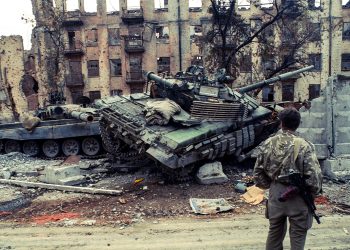
Unsecured Russian tank attack on Grozny centre; hundreds of tanks are set on fire or captured by the armed forces of the Chechen Republic of Ichkeria.

7-8 April 1995

The Russian army committed the Massacre of Samashki, use of vacuum bombs, splinter bombs and defoliation agents; 94 Chechen civilians tortured and killed.

31 August 1996

Khasavyurt Peace Agreement : An agreement on the basis for relations between the Russian Federation and the Chechen Republic is signed in Khassav-Yurt (Dagestan) by Aslan Maskhadov and Alexander Lebed in the presence of Tom Guildemann, head of the OSCE mission in Grozny.

5 January 1997

In accordance with the Khasavyurt Agreement, all Russian military units completely left the territory of the Chechen Republic of Ichkeria.

27 January 1997

Presidential and parliamentary elections in Chechnya organised by the OSCE. 72 observers and 200 journalists witness Aslan Maskhadov’s election as President with 59.3% of the vote.

12 May 1997

“Principles of Mutual Relations and Peace Treaty between the Chechen Republic of Ichkeria and the Russian Federation” is signed in Moscow by Presidents Maskhadov and Yeltsin.

27 August 1999

The Russian Federation once again began to war with air raids, and the whole of Chechnya came under artillery fire from a safe distance, with no regard for the civilian population.

5 February 2000

The Russian army committed a massacre in the village of Novye Aldi massacre. It was the mass murder of Chechen civilians, in which Russian forces (the paramilitary police of OMON from the northern Russian city of Saint Petersburg) went on a cleansing operation (zachistka), summarily executing dozens. The village had been cluster-bombed a day prior to the massacre, and local residents urged to come out for inspection the next day. Upon entering the village, Russian forces shot their victims with automatic fire at close range. The killings were accompanied by looting, rape, arson and robbery. As a result of the deadly rampage by Russian forces, up to 82 civilians were killed in the spree. Houses of civilians were burnt in an attempt to destroy evidence of summary executions and other crimes. Looting took place on a large scale and organised manner.

2 Feb 2005

President Aslan Maskhadov unilaterally declares one-month ceasefire to seek peace. Russian shows once again that they don’t search for peace but war, on March 8, they assasinate President Maskhadov.

23 November 2007

As a part of restruction of the government of the Chechen Republic of Ichkeria, Akhmed Zakayev was appointed as the “Prime Minister” in exile.
Sheikh_Mansur_Ushurma
Yermelov
Dadi-Yurt
War-Against-Russia
Baysangur
Imam-Shamil-Surrender
Deportation-to-Ottoman-Empire
Leaders_of_the_Mountainous_Republic_of_the_Northern_Caucasus
1944-deportation
deportation_1944
deportation-to-central-asia
deportation-of-Chechens
1991
Meeting-Grozny_1992
Chechen-Congress
manifestation
manifestation2
manifestation
Dudayev
31December1994
31December1994-russian-tanks
Samashki
Дагестан. Итогом прошедших в Хасавюрте переговоров секретаря Совета Безопасности России Александра Лебедя с начальником Главного штаба чеченских формирований Асланом Масхадовым стало подписание совместного заявления о принципах определения основ взаимоотношений между Российской Федерацией и Чеченской республикой. На снимке: Александр Лебедь и Аслан Масхадов (слева) во время подписания Хасавюртовских соглашений. Фото Алексея Федорова /ИТАР-ТАСС/.
Aslan-Maskhadov
Yeltsin-Maskhadov
Putin-Russian-Soldiers
akhmed_zakayev_
Close Search Window